
The Unified Farmer Relationship: From Crop Inputs to Grain Procurement
Managing your farmer relationships doesn't have to be a fragmented exercise in balancing disparate systems. The common approach overlooks the profound operational and financial advantages of connecting the inputs you sell in the spring to the grain you buy in the fall. Our method, the Unified Farmer Relationship, is built to manage this entire, year-round interaction on a single platform, providing a complete operational and financial view of every customer.
The Importance of Understanding Your Farmer Relationships
Many agribusinesses treat crop input sales and grain procurement as entirely separate business lines, managed by different departments using different software. This creates "parallel files" – a scenario where data about the same farmer exists in multiple, often conflicting, systems. As the old joke in data processing goes, "parallel files aren't" – meaning they rarely balance, leading to dual data entry, reconciliation headaches, and an incomplete picture of your customer's value and risk. This fragmented view makes it nearly impossible to quickly ascertain critical information, like an accurate inventory balance or the true value of unpriced grain, as one of our earliest multinational customers discovered while struggling with manual spreadsheets.
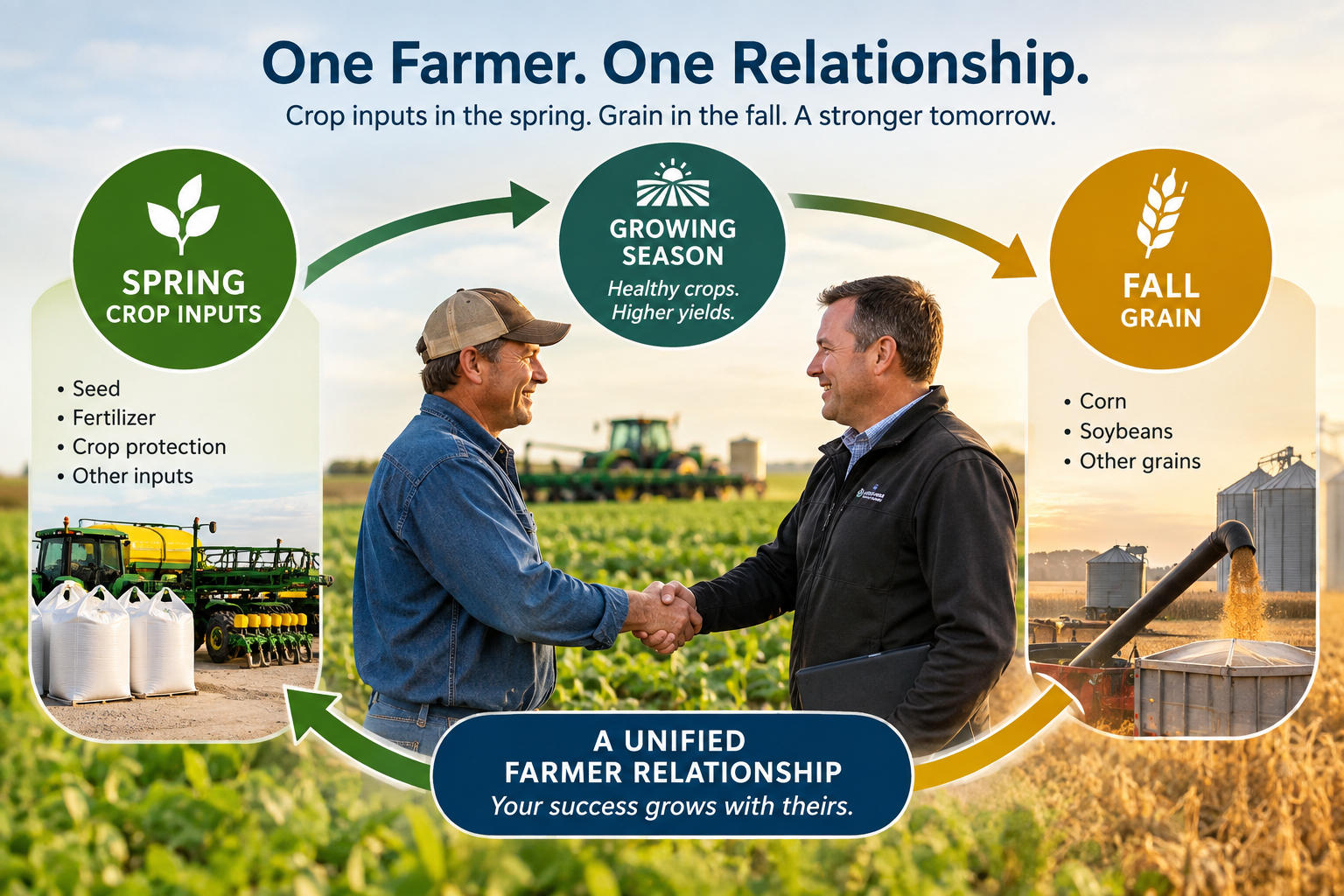
The Grossman Software Solutions Unified Farmer Relationship Method
Our approach integrates every touchpoint with your farmer customers, from the moment they buy seed to the final bushel delivered. This isn't a bolt-on feature; it's core to how Agrosoft and AgExceed are designed.
1. One Customer Profile: Accounts Payable Meets Accounts Receivable
Imagine a single customer profile that consolidates all transactions. With our method, you manage one comprehensive profile for each farmer, encompassing both their accounts payable (for grain purchases) and accounts receivable (for crop input sales). This ensures that all financial interactions, whether they're selling you corn or buying fertilizer, are recorded against the same customer record. This creates a single source of truth, reducing the risk and inefficiency of trying to port information between multiple systems to understand your entire customer relationship.
2. Grower Contracts: Linking Input to Output
The Unified Farmer Relationship utilizes 'Grower Contracts' to explicitly link the specific seed for crop input products sold to the grain you will later purchase and merchandise. This means if you sell a farmer a specific variety of corn seed, that information can be tied to the future grain contract for that corn. This provides traceability and foresight that generic accounting systems simply cannot offer, especially when dealing with the complexities of unpriced grain and the need to trace specific commodity characteristics.
3. Holistic Credit Management
By unifying AP and AR, you gain an unparalleled holistic view of credit management. You can instantly see a farmer's total financial standing with your business – their outstanding balances for crop inputs, their expected payments for grain deliveries, and their overall credit exposure. This allows for more informed credit decisions, better risk assessment, and a clearer understanding of your customer's financial health. You can see how the value of contracts, unpriced inventory, storage, futures, and owned grain fluctuates, giving you a better sense of your overall risk position.
4. Traceable Product Quality and Characteristics
From the seed you sell to the harvested commodity you buy, our method allows you to trace product quality and characteristics. If a specific seed variety is known for higher protein or oil content, that information can flow through the system, connecting the initial input to the final commodity. This ensures that when the farmer brings in a load, and adjustments are made for moisture or foreign materials, the complete history and expected quality are understood, creating better merchandising and inventory valuation. This is crucial for accurately tracing inventory cost and calculating true margins.
The Unified Farmer Relationship isn't just about efficiency; it's about strategic advantage. By connecting every part of the farmer lifecycle, you transform fragmented data into actionable insights, making your operations smoother, your decisions sharper, and your relationships stronger. This comprehensive approach is how Grossman Software Solutions delivers true Unified Commodity Management.
Related Questions
Q: How does unifying AP and AR benefit my accounting team? A: Unifying accounts payable and receivable into one customer profile dramatically reduces dual data entry and reconciliation efforts. Your accounting team gains a single source of truth for each farmer, simplifying end-of-month processes and ensuring consistent, accurate financial reporting without the struggle of balancing parallel files.
Q: Can this system handle the complexities of unpriced grain within a unified farmer profile? A: Yes, our system is specifically built to handle unpriced grain within the unified profile. It allows you to record inventory units and value in the general ledger even when the grain is unpriced, enabling proper valuation when it's brought to market or at period end, directly linking it to the farmer's overall financial picture.
Q: How does the "Grower Contract" feature help with inventory management? A: Grower Contracts link specific crop input sales to future grain purchases, providing clear visibility into expected inventory. This helps track potential commodity characteristics from the seed stage, improves forecasting of incoming grain, and ensures more accurate inventory valuation by understanding the full cost basis, including freight capitalization.
Start here: Grain Accounting Is Not Accounting: It's Unified Commodity Management